Design Parade 6

Jean-Louis Jabouin takes a look into the Design Parade 6, as well as its designers.

Art Rotterdam

Jean-Louis Jabouin discusses Art Rotterdam and how exciting it was.

Some New(ish) AutoCAD News

Some AutoCAD apps for those who love making things in the third dimension.

Megacon Photos

After a great weekend, Jean-Louis Jabouin talks about the highs and the lows.

What inspires you to design?

Jean-Louis discusses some great designs that he uses for inspiration.

Wednesday, March 30, 2011

My Weekend at Megacon '11 part 1


For those who don't know, Megacon is arguably the biggest Comic Book/Anime convention in Florida. It is normally held in the Orange County Convention Center. Now, having been a member of the Propeller Anime Club at Full Sail, I was given volunteering duties. Having worked the convention for 3 years, I knew the crap I would have to go through in terms of line control and setup. However, this year was different. Since I became a graphic designer, I had always taken pictures, conventions included. However, photography was never an actual duty within my schedule in convention volunteering. So, on top of the stuff I had to do, I was to deal with photography as well, be it panels, or events. I knew this was a great opportunity to show off some of my photography skills, and to make the news that much better, my 18-135mm diaphragm broke. Yeah!


     So let's start off with the hotel. I met up with a good friend of mine (we'll call him "Waldo"), and he asked if he was willing to share a room with someone over the weekend. He said he was. That's right, he was staying at the Peabody, a rather high-class-ish hotel that was located right next to the west concourse of the Orange County Convention. My Nikon D90 (don't worry, I borrowed a 18-70mm lens) battery was low, so I managed some great....

 ..and not-so-great shots.

Ugh.
So, yeah. I couldn't wait to start work the next day.

I woke up and started my venture towards the West Concourse. (and snuck some solid shots).


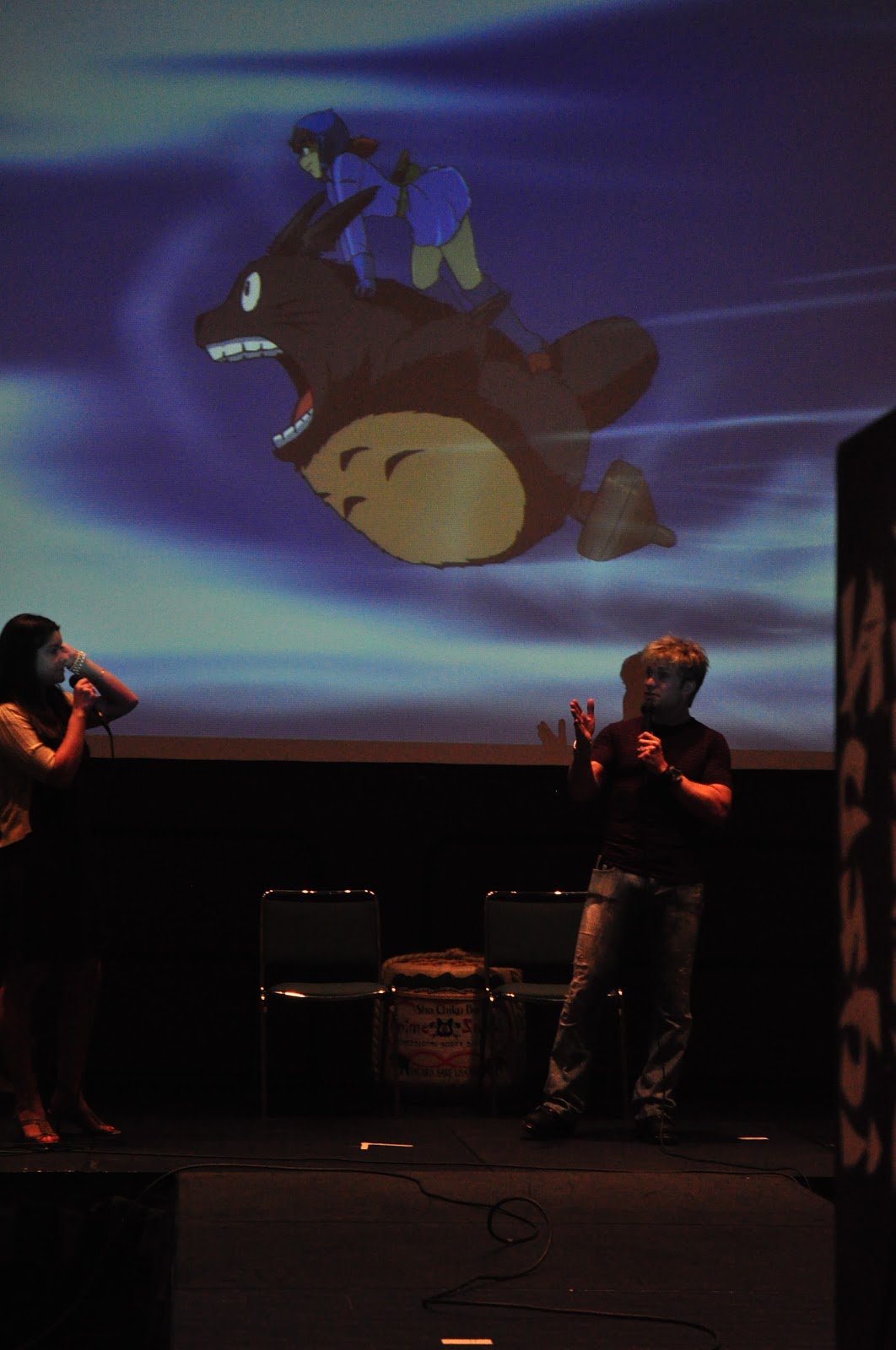
     I made it! Thankfully, all I had to do was to walk through this walkway adjacent to the hotel. I arrived at 224-B, where the volunteers were to meet. I was there extra early, so after setting my D90's battery charger on a random power strip, I took a look at my volunteer's schedule and saw that my first job was to do photography duty for the Trina Nakamura/Jaime Marchi panel. After meeting with Russell, the guy handling the video and film, we went straight to room 224 F/G/H (appropriately called the Main Event Room). We were greeted by the guys running the projectors and audio, as well as the hostesses of the panel. Trina Nakamura and Jaime Marchi, for those wondering, are Voice Actresses. Their resumes include Fruits Basket, Full Metal Alchemist, Soul Eater, Blassreiter, etc. I actually loved how down-to-earth they were, and it was a blast talking with and shooting images of their panel.


Here are some shots for you guys.


To be continued.... (417)

Friday, March 18, 2011

An Interview with anonymous designer

So, I made a list of questions to further my understanding of how a designer negotiates with a certain client, and I finally set the interview up. The man didn't want his name revealed, sorry guys. While I was getting his questions prepared, I realized that I forgot my pen. He offered me one, and I agreed. The first question I asked was how he uses objective criteria is his negotiations. He didn't quite understand, so I explained it to him. After face-palming himself, he basically said that sort normally applies when he states facts about what and what isn't possible, design-wise and whether or not a design could work, by citing examples. I then asked him a hypothetical question: What happens when a client thinks the design stinks whichever way you look at it? How do you separate the the people from the problem? He said, "Well first of all, if someone acted that way, then I will simply say 'thanks and bye.'" It's great to have clients and all, but if someone is going to be stubborn and mutual benefit simply isn't possible, why drag out the relationship? I agreed wholeheartedly with him. I myself have had clients who demanded that I do certain things like add clip art and lens flare when the result just wasn't going to be portfolio-worthy. The mutual benefit that he looked for was that the client gets his business promoted properly, while he gets to build his portfolio with yet another gem. I got ready for my next and final question. I asked, "Which of the 5 core concerns do you personally believe to be the most important?" He was now getting a drink. He then answered, "None of them are more important than the other, not overall, anyway. Sometimes one can be more important, but most of the time you cannot just generalize on all of them.". I agreed with him, once again. I wish my meeting was longer but he was really busy that day.

Wednesday, February 16, 2011

Art Rotterdam 2011

"Where the cutting edge between art and design becomes evident."
I know, another article notwithstanding of Photoshop and Autodesk. I also know that this event, apparently, has already happened. However, interior design does inspire my 3D work. This event is essentially the official side fair of Art Rotterdam, and the international fair for autonomous design. Occuring in the Las Palmas opposite the Art Rotterdam, this event was the first fair in the world, apparently, that focused exclusively on the most current developments of the autonomous world. The participants included Victor Hunt (Belgium), FAT Galerie (France), HELMINDERKNECHT (Germany), Mitterrand + Cramer (Switzerland), Atelier Barbara Broekman, Carla Koch, Eewal, Galerie Marzee, Judy Straten, Louise Smit, Particles Gallery, Priveelollektie, Ra, Rob Koudijs, SI Module | Sandberg Institute Applied Arts, Terra Delft, Thomas Eyck, Vivid Gallery, ZAND Galerie, and Zuiderzeemuseum (Netherlands). These designers are all very solid and creative with there fixtures and sets.


The events within this fair included a live performance from DE PLAYER, "Sound as a Weapon". DE PLAYER is essentially a performance art group that strays the line between experimental music, and visual art. 


Another event was Het Wilde Weten. It is a well known artists' space in Rotterdam. It houses 17 artists and a guest artist. The project space is a public platform for contemporary (my favorite) art, cultural discussions and debate. After last year's success, they will do the second edition of the WildBookMarket, and that is where artists and publishing companies from Rotterdam and around the world can meet and represent their most unique books. Artists from Het Wilde Weten include: Aaike Stuart, Anouk Griffoen, Boris Van Hoof, Dieuwertje Komen, Dirk van Lieshout, Elian Somers, Esther Kokmeijer, Jeroen Bosch, Jan Adriaans, Jetske de Boer, Kim Bouvy, Kim Zieschang, Marcha van den Hurk, Mariëlle Buitendijk, Marijke Appelman, Melle Smets and Sannetje van Haarst.

Recent Graphic Design Activity (sorry guys)

Mind Bending Time with TimeFX for the IPhone and IPad
Autodesk™ has released a free app for the Iphone and Ipad on the Apple Store, TimeFX. According to the article I have read, what makes this time app different from the many others in the market, is the fact that Autodesk™ is using some fluid dynamics used in programs like Maya that create some pretty cool aesthetics.


LightWave™ Artists Win Visual Effects Society 2011 Award for "Caprica"
(San Antonio – February 14, 2011) NewTek, a worldwide leader of 3D animation and video products, applauds the 2011 Visual Effects Society (VES) award-winners and nominees that count on NewTek LightWave™ to deliver groundbreaking visual effects tools for broadcast and film.
The LightWave 3D® VES 2011 award-winners and nominees are:
Winner: Outstanding Visual Effects in a Broadcast Series
"Caprica"
Airing on the Syfy Channel, "Caprica" is a science fiction family saga that takes place 58 years before "Battlestar Galactica," and follows two rival families as they grow, compete, and thrive in a society similar to our own. Entangled in the technology of artificial intelligence and robotics that will eventually lead to the creation of the Cylons, the two houses go toe-to-toe, blending action with corporate conspiracy.


Michael Gibson, VFX Producer
Gary Hutzel, VFX Supervisor
Davey Morton, VFX Artist
Jesse Toves, CGI Artist
Nominee: Outstanding Supporting Visual Effects in a Broadcast Program
"Undercovers"
From acclaimed writer/producer/director, J.J. Abrams ("Star Trek," "Fringe," "Lost," "Alias") and executive producer/writer, Josh Reims ("Brothers and Sisters," "What About Brian") this sexy, fun, action-packed spy drama proves once and for all that marriage is still the world's most dangerous partnership.
    
Jay Worth, VFX Producer / Supervisor
Andrew Waisler, VFX Supervisor
Ron Thornton, VFX Supervisor
Andrew Kramer, Digital Artist
About The Visual Effects Society (VES)The Visual Effects Society (VES) is the entertainment industry's only organization representing the full breadth of visual effects practitioners including artists, technologists, model makers, educators, studio leaders, supervisors, PR/marketing specialists and producers in all areas of entertainment from film, television and commercials, to music videos and games. Comprised of a diverse group of more than 2,200 members in 20 countries, the VES strives to enrich and educate its own members and members of the entertainment community at large, through a multitude of domestic and international events, screenings and programs.
About LightWave 
NewTek LightWave 3D® combines a state-of-the-art renderer with powerful, intuitive modeling, and animation tools. LightWave 10 is designed to support the creative process, providing the artist with the ability to interact in real time with 3D content, to work seamlessly with the full range of software applications in production pipelines and to render on unlimited render nodes. LightWave is enjoyed worldwide, as a complete 3D production solution for visual effects in film, television, broadcast graphics, print, games, visualization, and the Web, and is responsible for more artists winning Emmy® Awards than any other 3D application.

Wednesday, February 2, 2011

What Inspired You To Design?


A cute question to ask yourself today. Why do I love working with shapes, colors, and renders? Most Graphic Designers that I've had the privilege of working with have told me that design is something that they would do for free. The most recent designer I have personally heard this from was Colin Hesterly, a fellow graduate, and overall fantastic Graphic Designer. Now, normally his aesthetics are reminiscent of the 50's and 60's, as a matter of fact, his buddies also had a liking for that style. Looking at that, I instantly believed it. He genuinely took something that he loved (50's movies) and mixed it with his skills of motion graphics. That's what drives him. (I'd think)


I started off as a fine artist. As a kid, One of my favorite places to hang out was the Orlando Museum of Art.  I also visited the art festivals around Orlando, Florida, like ones held at Downtown Disney. They held panels from around the globe, and I was always wondering about what made someone look at something. I ended up painting some of my own pieces, acquiring a taste for ink and wash painting. Quite funny, in College, I have learned that the fundamental difference between fine art and graphic design was that in graphic design, it was mandatory to have a point. It was no longer about displaying what you felt 100% of the time, you actually had to think. It initially scared me, I'll be honest, but whenever I had a client, I would take some of the art elements I have learned (rule of thirds, color) and mixed it with my new found love for illustrations and photography.


Speaking of vector illustrations, that was the gateway form of graphic design that won me over to going to school. I remember looking at designers in the web, like Poked Studio. The simple shapes that somehow exuberated character. The textures within assets, somehow blending well with these flat colors. I wanted to learn that. So, I bought CS2 before college, and made banners for people in Photoshop. Silly me. When I learned the benefits of Illustrator in college, I wanted to hit myself. "The imagery is infinitely scalable??" I thought. I also didn't like the pen tool, a tool that many Graphic Designers need to complete their compositions. Now, I can't work past the bezier handles, haha. Scary enough, now I work on vector illustrations, motion graphics, photography, and 3D more than I do digital painting, a natural transition for a fine artist.


I will show the first Graphic Designers that influenced me to look into their portfolio, and in turn, go to school, and look for a career of my own.


Poked Studio

Gary Fernandez

Nick La

Erickson Enrique
So what inspires you to lose sleep and hygiene for this great occupation? Leave me a comment!


Sunday, January 23, 2011

Associations and Graphic Design - AIGA


Everyone is aware of how guilds and associations can benefit people of a certain profession. They'd hold events and offer inspiration, as well as opportunities for the people in question. Well, it's not much different to Graphic Designers. AIGA, the American Institute of Graphic Arts, is looking to advance design as a professional craft, and was founded in 1914, and it's the oldest and largest organization for designers and artisans alike.  I will go in-depth with the benefits this organization holds for guys in my industry, graphic design.


For one, AIGA holds the AIGA Design Conference biennially for its 20,000 or so design professionals (many of them including teachers and students) to celebrate design excellence, reinforce friendships and connections, stimulate the critical issues surrounding the world of design, and breed creativity, intuition, skill, and experience. While the events may be costly, $900 you are not a member for example, the aformentioned benefits can only be seen as a good thing.


Another benefit a Graphic Designer can get from something like AIGA, are the annual competitions. Nothing can bring someone's best better than a competition, in my humble opinion. As someone somewhere once said, competition breeds creativity. The term applies no better than here. AIGA this year will be hosting 2 competitions: 365 | Design Effectiveness and Making the Case. For 365 | Design Effectiveness, the Designer must submit what they believe is their best work in 3 areas of communicative design; Digital, Print, and Cross-Media, alongside a statement as to why it works. Making the Case is a completely new design competition, apparently. As expected, you must submit a case study of your work in communicative design. If the work is selected, the work is then shown in a traveling exhibition that debuts at the AIGA National Design Center.


Considering the possibilities that a Graphic Designer has with an association, I'd best consider looking into one. And if you don't want to spend alot of cash, AIGA still offers documents of inspiration, like the essays from professionals set to inspire future Graphic Designers, or the largest online design archive in the AIGA Design Archives, or if you are an aspiring Graphic Designer, and you don't know the salary range, you can still download the annual salary report. Maybe I should join myself, haha.

Friday, January 7, 2011

Inspirations of the moment - Cameron SInclair

"We believe that where resources and expertise are scarce, innovative, sustainable, and collaborative design can make a difference."

This was a quote that and emotional Cameron Sinclair said at a TED event, when he accepted his TED award. He started out training as an Architect and Designer, and well, joined Kate Stohr to form a nonprofit organization called Architecture for Humanity, where Architects can apply and hone their craft towards humanitarian efforts. as well as a Designer that has changed alot of unfortunate peoples' lives in the past 10+ years. He started with just $700 and a web site and is now offering solutions to housing problems around the world.


He started his speech with a little backstory. He stated that when he studied Architecture, he felt like "the black sheep of the family". He felt that many Architectures believed that when they designed, it was a jewel that they craved for, while in contrast, Cameron believed in a philosophy that I quite share: you design to improve or to create a detriment to the community in which you are designing in. In essence, you aren't designing for the residents or the guy who will use it, but the community as a whole. This quote was the seat clencher (?). That was the quote that had me sitting for the whole presentation. So after pausing the video to take notes, I continue..


He goes more in depth with Architecture for Humanity. He mentions how he started out in 1999 with his response to the housing crisis in Kosovo. With minimal revenue, and a simple website, in a rather short amount of time, thousands of people wanted to join the cause, which in turn led to prototypes and ideas being built. He continued on to mention his projects concerning HIV/AIDS and mobile health clinics in Africa, which led to 500+ responses from 50+ countries. I couldn't really believe it when he said that in 2004, in his more domestic projects, he found people in Montana, Louisiana, etc. that looked far worse than the developing countries he's visited.


With a tug at his jacket, he makes a broad and true statement. In the past 7 years, his experience showed him that there is a grassroots movement going on, of socially-responsible Designers who believe that the world has gotten alot smaller and that they realize that they have an opportunity, not a responsibility, to make a change. With a thousand or so Designers, and a staff of three, all connected through a website, They developed so that they had Advocacy, Instigation, and Implementation. They advocate for good design, not just through student lectures, or public forums, but also disaster mitigation and dealing with public policy. They instigate through the development of different ideas, putting up open-source design competitions. And obviously implementing the work. Doing the job.


Now, whilst this is a graphic design blog, I believe that the world of graphic design is broad. I have many great friends who have graphic design degrees, but work within the realm of 3D Architecture, and environment modeling, myself included at times. So this topic, in my opinion should hit home, not just with Architects, but with Graphic Designers. Scratch that, any Designer. He was a student of design that realized that there were certain parts of humanity that would not go away by itself, and for that, he gets my honorable mention.